
Why Keeping a Grow Journal Helps You Understand Plant Genetics
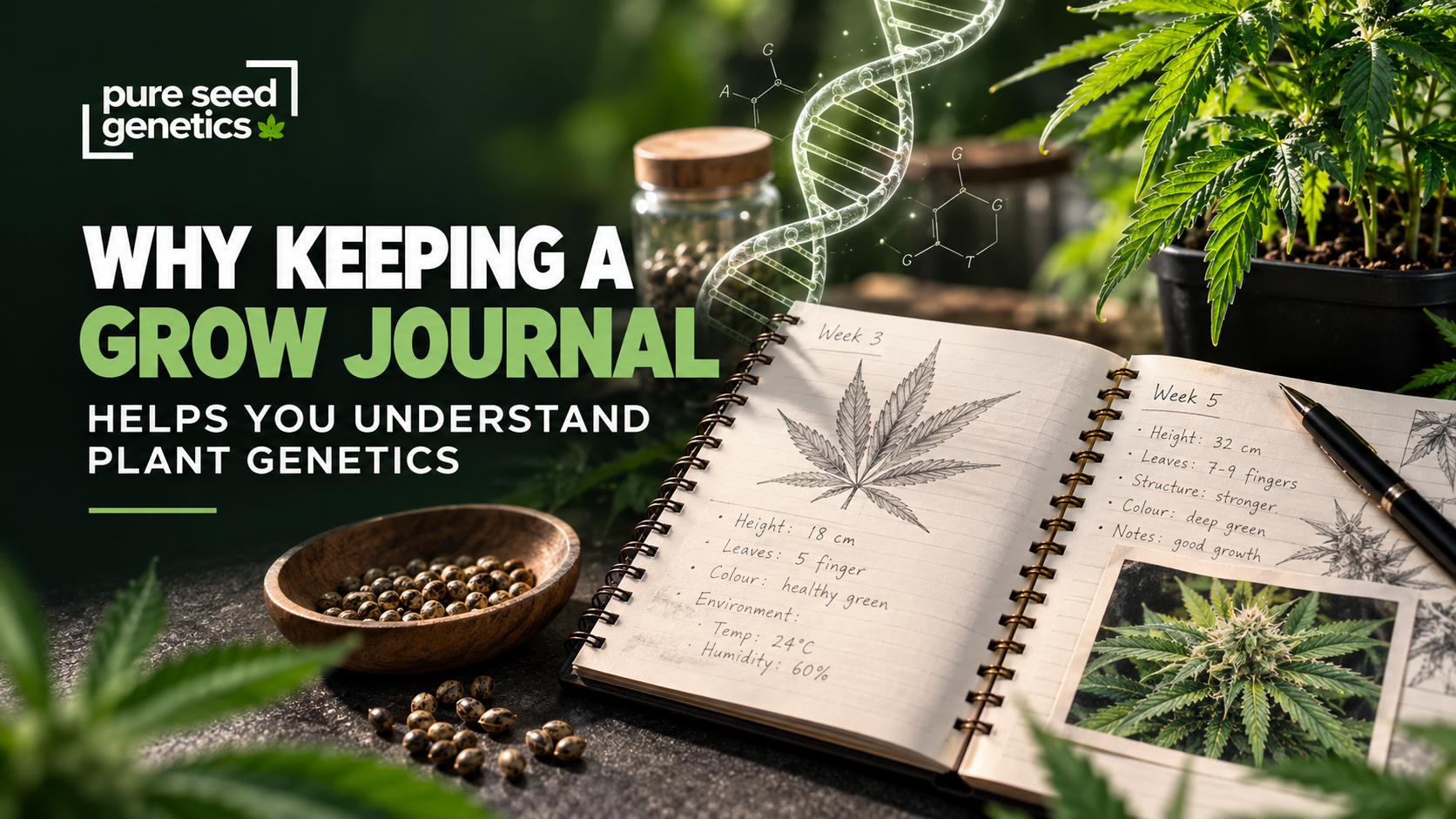
A plant’s development tells a story, but individual observations rarely explain the whole picture. A leaf may look different from one week to the next, plants from the same variety may develop different characteristics, and environmental changes can influence what you see.
Without reliable records, it is easy to forget when a change appeared or attribute it to the wrong cause.
A grow journal offers a practical solution. By recording observations consistently, you can build a clearer picture of plant development, recognise patterns, and better understand the relationship between genetic background and environmental influences.
For anyone interested in cannabis genetics, a journal is more than a diary. It is a structured record that helps turn individual observations into information that can be reviewed and compared over time.
What Is a Grow Journal?
A grow journal is a dated record of observations made throughout a plant’s development. Depending on its purpose, it may include photographs, environmental readings, visible characteristics, developmental changes, and notes about unusual events.
Some people use handwritten notebooks, while others prefer spreadsheets or digital documents. The format matters less than the accuracy and consistency of the information recorded.
A useful entry should answer three basic questions:
- What did you observe?
- When did you observe it?
- What conditions or changes might help explain it?
Keeping these details together makes it easier to review development over time instead of relying on memory alone.
1. Understand the Relationship Between Genetics and Environment
Genetics influences the characteristics a plant may express, but environmental conditions also affect how those characteristics develop.
Temperature, light availability, water conditions, nutrition, and other environmental factors can influence plant growth. Their effects depend on the plant, its developmental stage, and the characteristic being observed.
This helps explain why plants associated with the same variety may not look identical.
For a broader introduction to these concepts, read our guide to cannabis breeding, from landrace strains to modern hybrids. It explores how breeding and selection have contributed to the diversity of cannabis varieties.
A grow journal helps bring these ideas into context. If a visible change occurs around the same time as an environmental change, recording both events provides useful information for further investigation. It does not prove that one caused the other, but it creates a clearer starting point for understanding what happened.
2. Record Observable Traits, Not Assumptions
A journal becomes more useful when observations are specific rather than vague.
Instead of writing that a plant looks different, describe the change. You might record leaf shape, branching patterns, overall structure, colour, or the timing of a visible developmental stage.
Photographs can make these observations easier to review. Use consistent angles, similar lighting, and comparable framing when documenting the same plant over time.
It is equally important to distinguish between what you can see and what you think it means.
For example, recording a change in leaf colour is an observation. Concluding that the change proves a particular genetic characteristic is an interpretation that requires additional evidence.
This distinction is central to understanding plant genetics. Visible characteristics can provide useful clues, but appearance alone cannot establish a plant’s complete genetic identity.
3. Learn to Compare Varieties More Carefully
Comparing varieties can help readers understand the diversity of plant characteristics, provided the information is interpreted carefully.
Pure Seed Genetics offers several seed collections, including feminized seeds, autoflower seeds, and regular seeds. These categories provide a starting point for exploring different seed types and reviewing the information available for individual varieties.
For a practical example of variety-specific information, explore the Biscotti strain genetics and grow guide. It demonstrates how a variety can be discussed in terms of genetic background and reported characteristics.
When comparing varieties, avoid assuming that every visible difference comes from genetics. Environmental conditions, developmental stages, and natural variation may all contribute.
A journal allows you to document what you actually observe before drawing conclusions. This makes comparisons more systematic and helps separate reliable observations from expectations based on a variety name or description.
4. Use Dates to Put Changes in Context
A single photograph provides a snapshot. A series of dated photographs creates a timeline.
Recording when a characteristic first appeared, when it changed, and whether it remained consistent can help you understand the sequence of development.
Dates also make it easier to compare observations with other recorded information. If environmental conditions changed during the same period, you can review the timeline without relying on uncertain recollections.
Consistency matters. Use the same recording method whenever possible, and avoid changing the way you describe a characteristic from one entry to the next.
The aim is to make each observation understandable when you revisit it weeks or months later.
5. Keep Environmental Notes Alongside Plant Observations
Plant characteristics should not be evaluated in isolation. Environmental information gives observations additional context.
Depending on the purpose of your journal, relevant records may include:
- General temperature and humidity readings.
- Changes in lighting or surrounding conditions.
- Relevant watering or nutrition notes.
- Signs of stress, damage, or unusual development.
- Dates when a noticeable change was first observed.
You do not need to record every possible measurement. Start with information relevant to the questions you want to answer, then maintain the same approach over time.
Environmental records cannot establish causation on their own. However, they can help identify possible explanations and highlight situations that deserve closer examination.
6. Understand What Product Descriptions Can and Cannot Tell You
Seed descriptions can provide a useful reference when learning about varieties, but they should not be treated as guarantees of identical results.
When reviewing a product page, look for information about seed type, genetic background, and reported characteristics. Consider how clearly the information is presented and whether the claims are supported by the available documentation.
For example, the White Widow seed listing can serve as a starting point for examining a familiar variety’s product information. You can also browse the complete Pure Seed Genetics seed collection to compare the descriptions provided for different varieties.
Use the information as a reference, not as proof that every plant will display identical traits. A product description cannot account for every environmental condition or every form of biological variation.
A journal complements this information by documenting individual observations. It does not replace verified breeding records, genetic testing, or controlled research.
7. Build a Record You Can Maintain Consistently
The best journal is one you can keep up with. A complicated system that is quickly abandoned is less useful than a simple record that captures relevant details over time.
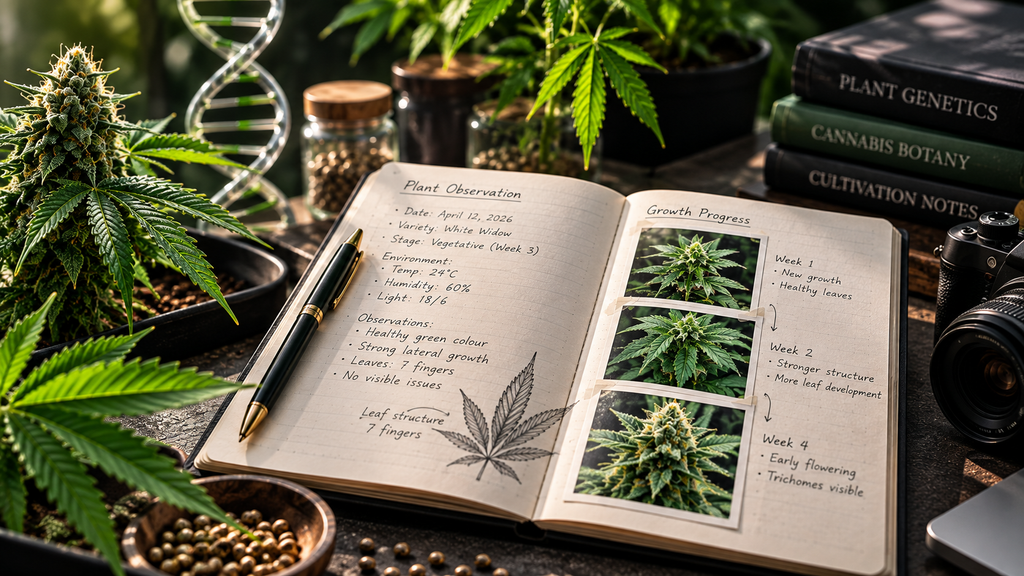
A basic entry can include:
Date: When the observation was made.
Plant or variety reference: A consistent identifier that distinguishes one record from another.
Observations: A factual description of visible characteristics or changes.
Environmental context: Relevant conditions or changes that were recorded.
Photograph: An image taken using a reasonably consistent method.
Questions to revisit: Anything that remains uncertain or needs further observation.
Keep descriptions objective. If a plant appears unusual, record the specific characteristic rather than immediately labelling it as a genetic variation, deficiency, or other condition.
This keeps the original evidence separate from your interpretation and makes later review more meaningful.
Common Grow-Journal Mistakes to Avoid
Even detailed records can become misleading when information is incomplete or inconsistent.
Relying on memory: Record observations close to when they occur rather than reconstructing a timeline weeks later.
Changing descriptions: Use consistent terminology so entries can be compared meaningfully.
Recording only unusual events: Routine observations establish a baseline that makes unusual changes easier to recognise.
Confusing correlation with causation: Two events occurring around the same time does not establish that one caused the other.
Drawing conclusions too quickly: An isolated observation rarely provides enough evidence to establish a general pattern.
Ignoring contradictory observations: Accurate records should reflect what happened, not only the results you expected to see.
The purpose of a journal is not to confirm an existing belief. It is to create a dependable record that allows your understanding to improve as more information becomes available.
How Grow Journals Support a Better Understanding of Genetics
Genetics helps explain why plants inherit certain characteristics, while environmental conditions influence how those characteristics develop and appear.
A grow journal brings these ideas into a practical context by documenting what happened, when it happened, and what else was occurring at the time.
It cannot independently confirm genetic identity or replace scientific testing. It can, however, help organise observations, improve comparisons, and identify questions worth investigating.
For further reading, explore our guide to cannabis breeding and genetic development and browse the Pure Seed Genetics shop to review the variety information available across our seed collections.
Combining careful observation with reliable reference material encourages a more thoughtful approach to understanding plant characteristics.
Final Thoughts
Understanding plant genetics takes more than recognising a familiar leaf shape or noticing a particular growth pattern. It requires attention to variation, environmental influences, and the quality of the evidence behind each conclusion.
A consistent grow journal helps bring these details together. By recording dates, photographs, observable traits, and relevant environmental information, you can build a clearer history of plant development and make more informed comparisons.
At Pure Seed Genetics, we believe that understanding begins with asking better questions. Careful observation is a useful place to start.

Pure Seed Genetics
Cannabis seeds for sale with free shipping to Canada, the US and Australia. Our weed seeds are bred to meet customer and breeders standards of growing of all levels and tastes.
Copyright 2026 © Pure Seed Genetics
