
Beyond THC: Comparing Cannabis Seed Varieties
When comparing cannabis seed varieties, THC percentage is often one of the first details people notice. A higher number can look impressive, but it does not tell the whole story about a variety.
Two varieties with similar THC figures can have very different genetic backgrounds, cannabinoid profiles, terpene characteristics, flowering behaviours and growth patterns. Looking at just one number can therefore make it difficult to understand what actually separates one variety from another.
A more useful comparison starts with the complete picture. Understanding genetics, seed type, cannabinoid information, terpene profiles and reported plant characteristics helps you interpret product descriptions more carefully and make better-informed comparisons.
Whether you are exploring different genetic backgrounds or browsing a seed catalogue, here are the details worth considering beyond THC percentage.
1. Start With the Genetic Background
Genetics provide the foundation for understanding a cannabis seed variety. They influence inherited characteristics and help explain why different varieties can display different traits.
When comparing seed varieties, look for information about:
- Genetic lineage or reported parent strains
- Indica, sativa or hybrid classification
- Whether the variety has a documented breeding background
- Whether it belongs to a recognised genetic line
- How much information is available about its inherited characteristics
Lineage can help explain the background of a variety, but it should not be treated as a guarantee that every plant will express identical characteristics.
For example, two varieties may share a parent strain but still differ in their reported flowering behaviour, aroma profiles and other characteristics.
If you want to understand how genetic backgrounds develop, read our guide to how cannabis breeding works.
2. Understand THC and CBD Together
THC and CBD are two different cannabinoids found in cannabis. Their reported concentrations can help describe a variety’s cannabinoid profile, but THC alone does not provide a complete comparison.
Here are three details worth checking.
THC percentage
THC is a cannabinoid commonly highlighted in product descriptions. However, a reported percentage should be treated as product-specific information, not a guarantee of the final cannabinoid concentration of every plant.
CBD percentage
CBD is another important cannabinoid to consider. Some varieties are specifically described by their higher CBD content or their reported CBD-to-THC ratios.
The relationship between cannabinoids
A variety described as having a 1:1 CBD-to-THC ratio has a different reported cannabinoid balance from one described as having a 1:18 ratio.
These figures are useful for understanding the information provided by a seed seller, but they should not be interpreted as guaranteed laboratory results unless supported by appropriate testing.
Readers interested in this category can explore the CBD Seeds collection.
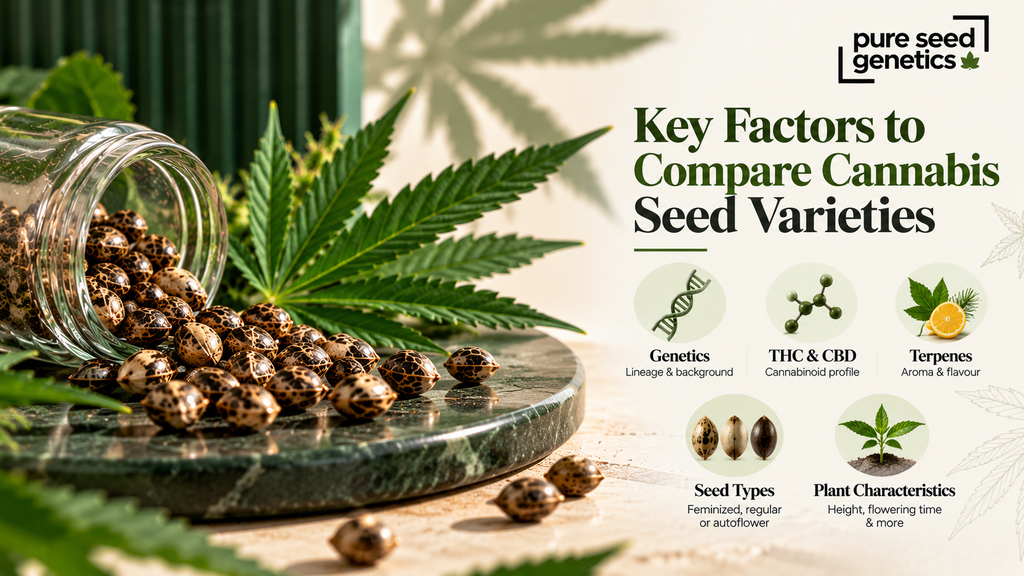
3. Look Beyond the Name at Terpene Information
Terpenes are naturally occurring aromatic compounds found in many plants, including cannabis. They contribute to the distinctive aromas associated with different varieties.
Product descriptions may use terms such as:
- Citrus
- Earthy
- Pine
- Sweet
- Fruity
- Spicy
- Herbal
These descriptions can help distinguish varieties with different reported aromatic characteristics.
However, aroma descriptions are not the same as a verified terpene analysis. If a product listing provides specific terpene percentages or laboratory results, check whether the information is supported by testing.
When comparing varieties, look for descriptions that explain the reported aroma profile rather than relying on a strain name alone.
4. Understand the Different Seed Types
Seed type is one of the most practical details to consider when comparing products. Terms such as feminized, regular and autoflower describe different characteristics of the seed.
Understanding these categories helps prevent comparisons between products that are not necessarily designed around the same characteristics.
Feminized seeds
Feminized seeds are produced through breeding approaches intended to increase the likelihood of female plants.
They are a distinct seed category and should not be confused with autoflowering genetics. A feminized variety can also be photoperiod-dependent.
Explore the Feminized Seeds collection.
Regular seeds
Regular seeds can produce male or female plants. They are often relevant to people interested in traditional breeding genetics and studying variation within a genetic population.
Their classification describes the expected sex distribution, not the complete genetic quality of a variety.
Explore the Regular Seeds collection.
Autoflower seeds
Autoflowering varieties have genetics associated with flowering that is less dependent on changes in day length than traditional photoperiod varieties.
This is a genetic and flowering characteristic, not a measure of THC content or overall quality.
Explore the Autoflower Seeds collection.
5. Compare Reported Plant Characteristics
A product description can contain several useful details beyond cannabinoid percentages.
Depending on the available information, these may include:
- Reported plant height
- Flowering time
- Indica or sativa dominance
- Genetic background
- Reported aroma characteristics
- Autoflower or photoperiod classification
These details help you understand how two varieties differ on paper.
For example, a product described as a shorter autoflowering variety is not directly comparable to a taller photoperiod variety simply because both have similar reported THC percentages.
It is also important to distinguish between flowering time and the complete plant life cycle. A stated flowering period does not necessarily represent the total time from seed to maturity.
Always compare the same types of information wherever possible.
6. Check Whether the Information Is Specific and Verifiable
Not every product description provides the same level of detail.
Some listings include genetic lineage, cannabinoid information and flowering characteristics. Others provide only a name and a short description.
A more informative product listing should make it reasonably clear which details are documented, which are reported characteristics and which are general descriptions.
Before relying on a specification, consider:
Is the information clearly presented?
Look for specific descriptions rather than broad claims such as premium genetics or exceptional quality without supporting details.
Are laboratory results available where relevant?
If a seller provides cannabinoid or terpene testing information, check whether the results relate to the specific product or batch being described.
Is the genetic background explained?
A documented lineage can provide more useful context than a variety name on its own.
Are claims realistic?
Be cautious of absolute guarantees about yield, potency, uniformity or performance. Genetic characteristics can vary, and product descriptions should not be mistaken for guaranteed outcomes.
7. Why Two Varieties With Similar THC Levels Can Still Be Different
Consider two hypothetical cannabis seed varieties, both listed with a reported THC level of 20%.
| Characteristic | Variety A | Variety B |
|---|---|---|
| Reported THC | 20% | 20% |
| Genetic classification | Indica-dominant hybrid | Sativa-dominant hybrid |
| Seed type | Feminized photoperiod | Autoflower |
| Aroma description | Earthy and spicy | Citrus and fruity |
| Flowering behaviour | Photoperiod-dependent | Autoflowering |
Although the reported THC figures are identical, the descriptions show that these are not interchangeable varieties.
Their genetic classifications, seed types, aromatic descriptions and flowering behaviours differ.
This is why a single percentage should never be the only factor used to compare cannabis seeds.
The example is illustrative, not a comparison of tested PSG products.
8. A Practical Checklist for Comparing Cannabis Seeds
When browsing a seed catalogue, use the following checklist to organise the information.
| What to check | Why it matters |
|---|---|
| Genetic lineage | Provides background about the variety |
| Seed type | Identifies regular, feminized or autoflower classification |
| Flowering type | Distinguishes photoperiod from autoflowering genetics |
| THC information | Describes the reported THC profile |
| CBD information | Adds context to the cannabinoid profile |
| Terpene information | Helps explain reported aromatic characteristics |
| Flowering time | Provides an estimate of the flowering period |
| Plant characteristics | Helps distinguish reported physical traits |
| Product documentation | Helps assess how well claims are supported |
Not every listing will contain every detail. When information is missing, it is better to recognise that limitation than to assume an answer.
9. Common Mistakes When Comparing Seed Varieties
Even experienced readers can overlook important differences when browsing a large seed catalogue.
Here are some common mistakes worth avoiding.
Choosing based only on THC percentage
A higher reported THC figure does not automatically make one variety better than another. Genetics and other characteristics matter too.
Assuming similar names mean similar genetics
Strain names can be reused or associated with different genetic backgrounds. Check the actual product description rather than relying on the name alone.
Confusing seed types
Feminized, regular and autoflower describe different characteristics. They should not be treated as interchangeable terms.
Treating marketing descriptions as laboratory results
A product description can provide useful information, but it is not a substitute for verified testing.
Ignoring missing information
If a product does not provide details about lineage, cannabinoid profiles or other characteristics, do not fill in the gaps with assumptions.
10. Explore Cannabis Seed Collections at Pure Seed Genetics
Comparing cannabis seed varieties becomes easier when product information is organised into clear categories.
At Pure Seed Genetics, visitors can explore different collections, including feminized, regular, autoflower and CBD seeds.
Rather than focusing on one headline figure, take time to compare the genetic background, seed classification and reported characteristics of each listing.
You can start with the Pure Seed Genetics shop and explore the available collections to understand how different varieties are described.
The aim is not simply to find the highest number on a product page. It is to understand what the available information actually tells you about each variety.
Final Thoughts
Comparing cannabis seed varieties requires more than looking at THC percentages. Genetic background, cannabinoid information, terpene descriptions, seed classification and reported plant characteristics all contribute to a more complete understanding of a product.
The most useful comparisons come from looking at the available information as a whole, recognising the difference between reported characteristics and verified results, and avoiding assumptions based on a variety name or a single number.
At Pure Seed Genetics, take the time to explore the product descriptions and compare the details that matter. A better-informed comparison starts with asking better questions.
Frequently Asked Questions
Is THC percentage the most important factor when comparing cannabis seeds?
No. THC is one part of a product’s reported cannabinoid profile. Genetic background, seed type, CBD information, terpene descriptions and other characteristics also help distinguish varieties.
What is the difference between THC and CBD?
THC and CBD are separate cannabinoids found in cannabis. They have different chemical and pharmacological properties, and their reported concentrations can vary between varieties.
Do two cannabis varieties with the same THC percentage have the same characteristics?
No. Two varieties can have similar reported THC percentages while having different genetic backgrounds, seed types, aromatic characteristics and flowering behaviours.
What does genetic lineage mean?
Genetic lineage refers to the reported ancestry or parentage of a variety. It provides context about its genetic background but does not guarantee that every plant will express identical characteristics.
Are feminized and autoflower seeds the same thing?
No. Feminized describes the breeding intention regarding plant sex, while autoflower describes flowering behaviour. These terms refer to different characteristics.
Why should I check product information before comparing seeds?
Product information helps you understand what is actually being offered. Checking lineage, seed type, cannabinoid details and other reported characteristics makes comparisons more meaningful.

Pure Seed Genetics
Cannabis seeds for sale with free shipping to Canada, the US and Australia. Our weed seeds are bred to meet customer and breeders standards of growing of all levels and tastes.
Copyright 2026 © Pure Seed Genetics
